Ramaiah Institute of Science and Management (RISM), in collaboration with the University at Albany (State University of New York), today held a high‑level Curtain Raiser convening leaders from academia, industry, research and technology to outline a shared vision for reimagining higher education in India. Framed as a strategic forum, the event set out RISM’s institutional roadmap to close systemic gaps between learning, capability and measurable societal impact through interdisciplinary education, AI‑enabled pedagogy and translational research.
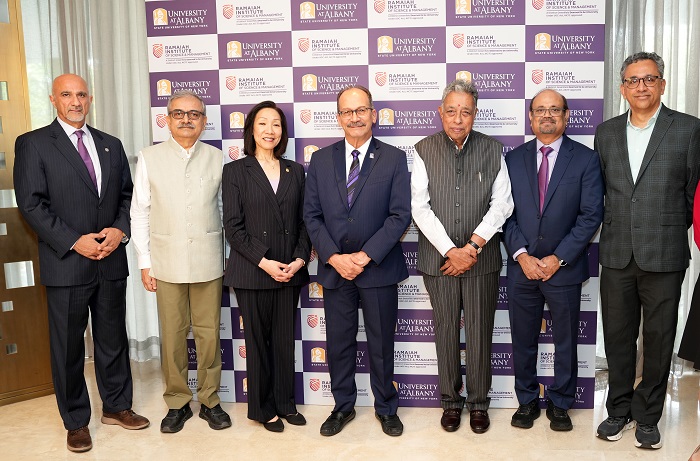 |
Dr. M R Jayaram and Havidán Rodríguez with senior leaders of RISM and the University at Albany during the launch of the Ramaiah Institute of Science and Management
Prof. Gurucharan, Executive Director and Chief Strategic Officer, Gokula Education Foundation (Medical), called for a fundamental reorientation of universities’ purpose: to prepare students for an AI‑shaped world where human judgement, creativity and ethics remain central. He urged institutions to ensure AI amplifies learning, not replaces it, and to shift academic programmes toward interdisciplinary problem‑solving and systems thinking that mirrors real‑world complexity.
A fireside conversation between Dr M. R. Jayaram, Chairman of Gokula Education Foundation (Medical) and Chancellor of RISM, and Dr. Havidan Rodriguez, President of the University at Albany, underscored the partnership’s global ambition. Dr. Jayaram described the new university’s mission to bridge the industry–academia divide and transition from publication‑centred output to deep science translational research that delivers products, processes and societal solutions. President Dr. Rodríguez emphasised co‑creation rather than replication: the collaboration seeks to build a new higher‑education model that augments, not replaces, human capabilities with AI.
Three focused panels explored actionable pathways:
-
The Future of Engineering Education: Moderated by Prof. Shivakumar Sastry, experts from academia and industry highlighted the need to move beyond siloed curricula to outcome‑driven, systems‑oriented learning. Recommendations included embedded industry capstones, long‑term projects, faculty support for new pedagogy, and student agency in problem selection.
-
AI in Higher Education — The Creative Disruptor: Led by Prof. C. Pandu Rangan, and panellists agreed that generative AI commoditises execution while increasing the value of critical thinking, ethics and process‑oriented assessment. Institutions must redesign learning and assessment to cultivate human–AI teaming and higher‑order skills.
-
Translational Research & Industry Partnerships: Moderated by Mr Venkatesh Valluri, the discussion showcased case studies where industry collaboration and iterative, society‑engaged research accelerated product development and impact. Panellists urged prioritising translation over patents, and equipping students and faculty to innovate with market orientation.
In closing, Prof. B. N. Raghunandan Chairman RISM Task Force synthesised five priorities: systems approaches, social skills, unified multidisciplinary engineering, continuous faculty development, and a focus on translational research.
Dr. Jayaram Chairman and Chancellor said, "Our Vision for 2035 is RISM aims to be recognised as the university that prepared a generation not merely for jobs, but for shaping the future."